
Formula Ownership in a Haircare Launch: A Buyer's Checklist
For a haircare brand, formula ownership is really three questions in one: who owns the scent concentrate, who owns the product base, and who holds the records that let either one be reproduced. Left implied, each question becomes a dispute at the worst possible moment, usually when the line changes factories or a competitor launches something suspiciously similar. A first-time founder who settles all three in writing before the first sample avoids most of the expensive surprises a haircare launch can carry. The checklist below is the one to work through before any deposit.
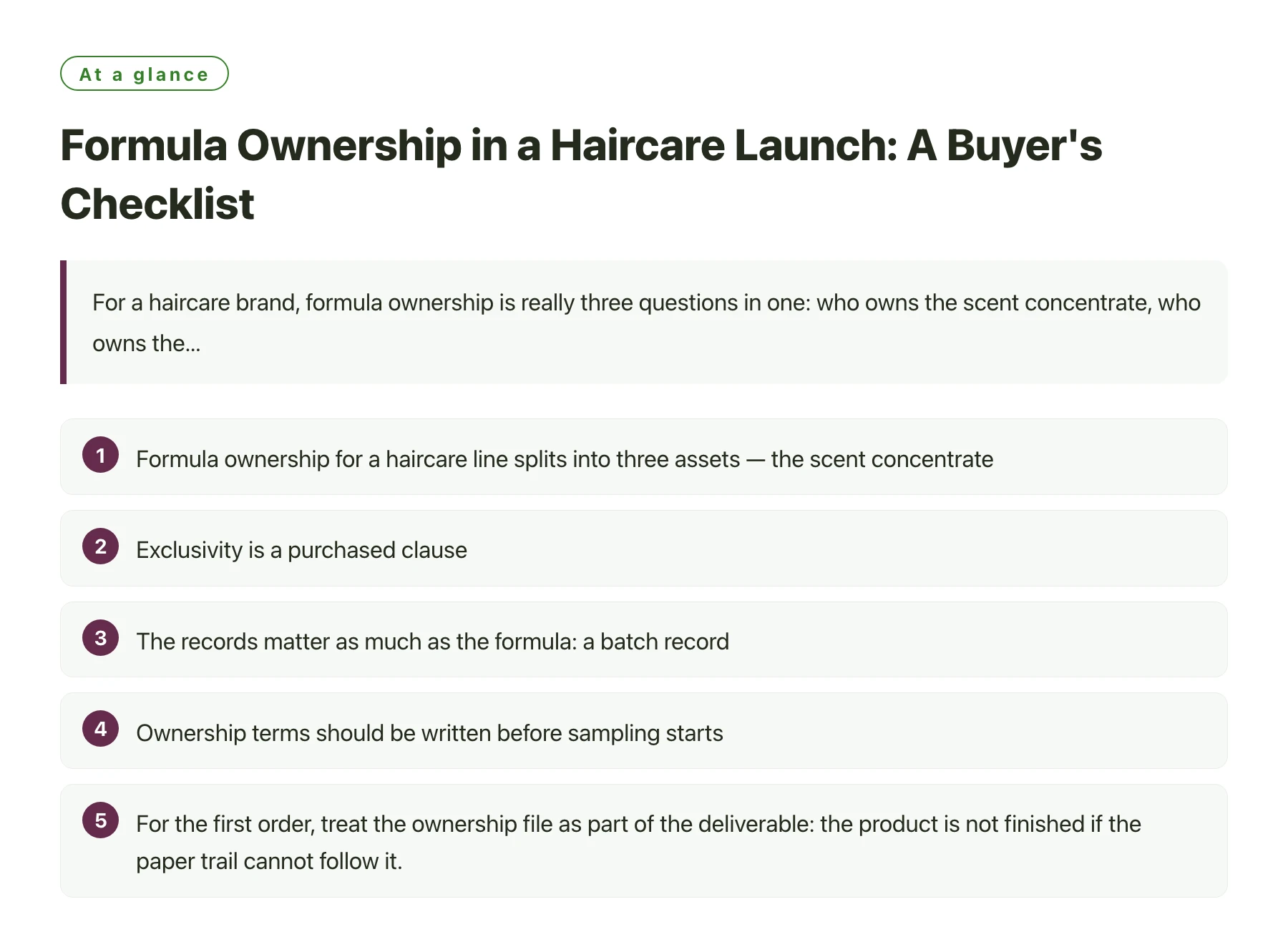
Key takeawaysFormula ownership for a haircare line splits into three assets — the scent concentrate, the product base and the documentation — and each can be held by a different party. · Exclusivity is a purchased clause, not an assumption; without it, the manufacturer may offer the same starting point to another client. · The records matter as much as the formula: a batch record, a stability file and a signed reference sample are what let another factory reproduce your product. · Ownership terms should be written before sampling starts, because once the rounds begin, both parties behave as though the question was already answered. · For the first order, treat the ownership file as part of the deliverable: the product is not finished if the paper trail cannot follow it.
Most first-time haircare founders start with the product and arrive at ownership by accident. They choose a shampoo base, fall in love with a scent direction, approve a sample, and only later discover that the concentrate was developed from a shared accord, that the base is a supplier-standard formula, and that the phrase 'our formula' was never defined anywhere.
The fix is to define the assets before the chemistry. This article walks through the three assets a haircare formula actually contains, the checklist that settles who owns each one, and the verification steps worth taking before money changes hands.
The three assets inside a haircare formula
A haircare product carries at least three distinct pieces of intellectual property, and confusing them is where most ownership problems start.
The scent concentrate
The fragrance oil is the asset most founders mean when they say 'our scent'. It is usually developed by or with a perfumer, often from a shared starting point, and its ownership determines whether another client can be offered the same smell. If the concentrate is the reason a buyer chooses the product, exclusive ownership is the point of the entire project.
The product base
The shampoo, conditioner or leave-in base is frequently a supplier-standard formulation with its own chemistry. Owning or licensing it is a separate negotiation: some brands are happy to use a standard base, while others need the base itself to remain exclusive or at least portable to a second factory.
The paper trail
The batch record, the stability file, the certificates and the signed reference sample are what turn 'we developed it' into 'we can reproduce and defend it'. A formula without its records is a memory, and memories do not transfer between factories.
The ownership checklist
| Question | What a 'yes' means | Where to record it |
|---|---|---|
| Who owns the scent concentrate? | You can move it to another manufacturer and reproduce the product | Development agreement |
| Is the accord exclusive to your line? | The same starting point will not be re-offered to other clients | Exclusivity clause |
| Who owns the product base formula? | You control changes, reformulations and a factory switch | Supply or licence terms |
| Who holds the mould and design files? | You can reorder packaging elsewhere without paying twice | Tooling agreement |
| What documentation transfers when the project ends? | Batch record, stability file and certificates move with the product | Delivery list in the contract |
| Is there a signed reference sample? | Disputes can be settled against a physical standard instead of a memory | Sample record signed by both parties |
Read the middle rows first. Founders frequently negotiate the concentrate price and never mention the base or the mould, then discover at the switch that the cheapest part of the product was the part they did not own.
What to verify before you sign
The checklist only works if the answers are checkable. Two verifications matter more than the rest: whether the manufacturer's stated scope matches what you are buying, and whether the documentation would actually leave with you.
Check the stated scope
A manufacturer that handles development, filling and packaging under one roof answers the scope question in a single list, which makes the contract much easier to compare. A supplier whose service description is published — the kind of scope you can read on Xuelei official website — is easier to check than one that describes everything only in a meeting.
Test whether the product can follow you
If the relationship ended next quarter, could a second factory reproduce the product from the documents you hold? If the answer is no, the gap is a clause that has not been negotiated yet, not a technical problem.
Confirm who registers what
Industrial designs and packaging can be registered through national offices or through the international route administered by WIPO; registration only protects the brand if the brand, not the supplier, holds it [1].
The cheapest insurance in the whole project is one page: the model, the ownership of the concentrate, the base and the mould, the exclusivity scope, and the list of documents that transfer. Have both sides sign it before the first sample round. Everything else in the project can move; those five lines should not.
Turning the checklist into a contract page
Once the answers are known, they belong in one signed document alongside the production terms. The signature is what makes the checklist a contract, and the date on it matters: ownership fixed after sampling is renegotiation, ownership fixed before sampling is negotiation.
The verification work continues after signing. Batch-level testing against GMP frameworks such as ISO 22716 is routinely performed or witnessed by third-party laboratories, and asking for that evidence on the first order is normal practice [2]. Market rules bind the finished product as well: in Canada, for example, cosmetics must meet safety requirements and be notified before sale, and the owner of the file is the one who answers for it [3].
The closer the manufacturer is to a one-stop operation — fragrance manufacturing under one roof — the less the ownership file scatters across subcontractors, and the easier it is to audit. That is a structural argument for checking the scope before you compare prices.
Sources
- WIPO — World Intellectual Property Organization —— The UN agency for intellectual property; resources on industrial design and patent protection relevant to product and packaging design.
- SGS: Cosmetics, Personal Care & Household Testing —— Testing, inspection and certification services for cosmetics and personal care, including microbiological, stability and safety testing aligned with cosmetics GMP.
- Health Canada: Cosmetic Safety —— Health Canada's cosmetics pages, covering cosmetic notification, the ingredient hotlist and safety requirements for cosmetics sold in Canada.
Frequently asked questions
Can I own the formula but not have exclusivity?
Yes, and the two should be negotiated separately. Ownership means you can reproduce the formula; exclusivity means the starting point will not be offered to other clients. Without an exclusivity clause, assume the accord may be shared.
Who usually owns a supplier-standard shampoo base?
Typically the manufacturer, offered under licence for your order. If you need the base to be yours or to move to a second factory, that has to be negotiated and written down; a standard base is rarely transferable by default.
What records should I receive with my first order?
At a minimum: the batch record for the run, the stability and compatibility summary, the certificates relevant to your market, and the approved reference sample. The list belongs in the contract so that 'we will send it later' does not become 'it was never agreed'.
How do I protect my scent name and packaging?
Trademarks cover the name and industrial design registration covers the bottle; both sit outside the manufacturing contract and are filed by the brand. Registering through the WIPO international route is an option when you sell in several countries at once.
Do I need exclusivity for a first small launch?
Not necessarily, but decide it deliberately. If the first launch is a test, a shared starting point may be acceptable and much cheaper. If the scent is the product, exclusivity is the asset, and paying for it early is cheaper than rebuying it after success.
See it on your home before you commit.
Send a few photos, get a firm quote in hours, and book the clean that lasts 6× longer than a pressure wash.