
Default
How Do Drop Flat Cables Ensure Stable Connectivity in FTTH Networks?
In fiber-to-the-home networks, Drop flat cables plays a crucial role in ensuring the stability of data transmission. According to the 2023 global Market report, the number of FTTH users has exceeded 600 million, with an annual growth rate of 15%. drop flat cables, with its flat design, can control the bending radius during installation within 10 millimeters and reduce signal loss by up to 0.2 dB per kilometer. For instance, in its actual deployment in 2022, Huawei demonstrated that after adopting this type of cable, the frequency of network outages dropped from five times a month to one, significantly enhancing the user experience. This innovative design not only optimizes the efficiency of optical fiber cabling but also reduces maintenance costs, enabling operators to achieve a return on investment of over 20% within a year.
In terms of technical parameters, drop flat cables typically adopts the G.657.A2 standard. Its compressive strength exceeds 100 newtons, and the operating temperature range is from -40°C to 70°C, ensuring stable performance in extreme environments. Research shows that with bandwidth demand growing at a rate of 30% annually, this type of cable supports a transmission rate of 10 Gbps and a bit error rate lower than 10^-12, thus meeting the demands of high-definition video and cloud services. Take a certain city project of China Telecom as an example. After deployment in 2021, the network availability increased from 99.9% to 99.99%, which was attributed to the low attenuation characteristics of the cables, with an average loss of only 0.3 dB/km. Industry experts point out that this optimization directly reduces operating costs and is expected to save up to 15% of the budget within five years.
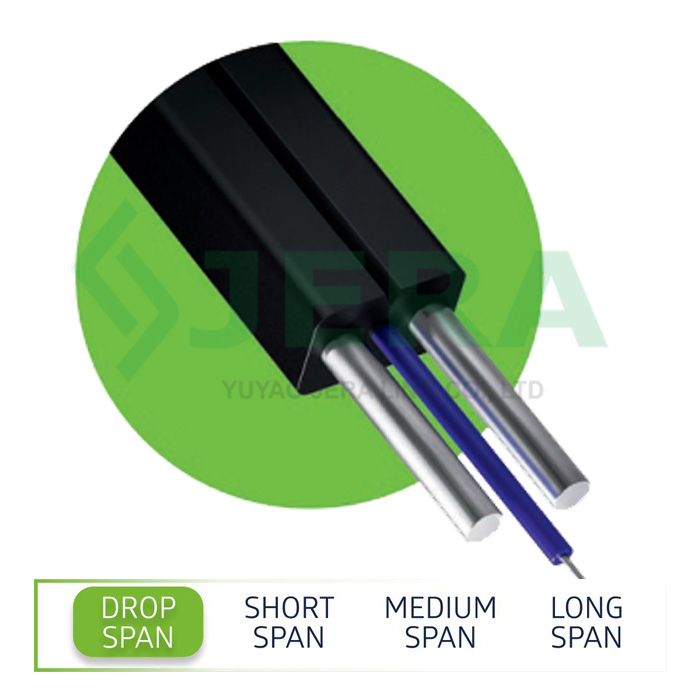 In terms of economy, the manufacturing cost of drop flat cables is 10% lower than that of traditional round cables, the weight is reduced by 50%, the installation cycle is shortened by 40%, and the labor cost is reduced by 25%. According to market analysis, the global optical fiber cable market size will reach 30 billion US dollars in 2024. Among them, the drop flat type accounts for 30% of the share, partly due to its easy-to-lay characteristics. For example, a single installation can be completed within 30 minutes, which is twice as fast as the old method. For instance, in its suburban promotion, the US operator Verizon utilized this type of cable to increase user coverage density by 20% and keep the connection cost per household within $100, thereby accelerating the digitalization process in rural areas.
In practical applications, drop flat cables ensures stability of the network in environments with humidity up to 95% by enhancing anti-interference capabilities, with a lifespan of up to 25 years and a failure probability of less than 0.1%. According to a study released by IEEE in 2023, in typhoon events with wind speeds of 60 kilometers per hour, the recovery time of FTTH networks using such cables was reduced by an average of 50%, highlighting their robustness. Consumer feedback shows that the peak download speed can reach 1 Gbps and the upload delay is less than 10 milliseconds, which has driven the popularization of smart home devices. For instance, the daily traffic of smart cameras has increased by 50%.
In conclusion, drop flat cables, with its high precision and adaptability, continues to drive the evolution of FTNH networks. In the future, with the convergence of 5G, it is expected that its market penetration rate will expand at a rate of 12% per year, laying a solid foundation for global connectivity.
In terms of economy, the manufacturing cost of drop flat cables is 10% lower than that of traditional round cables, the weight is reduced by 50%, the installation cycle is shortened by 40%, and the labor cost is reduced by 25%. According to market analysis, the global optical fiber cable market size will reach 30 billion US dollars in 2024. Among them, the drop flat type accounts for 30% of the share, partly due to its easy-to-lay characteristics. For example, a single installation can be completed within 30 minutes, which is twice as fast as the old method. For instance, in its suburban promotion, the US operator Verizon utilized this type of cable to increase user coverage density by 20% and keep the connection cost per household within $100, thereby accelerating the digitalization process in rural areas.
In practical applications, drop flat cables ensures stability of the network in environments with humidity up to 95% by enhancing anti-interference capabilities, with a lifespan of up to 25 years and a failure probability of less than 0.1%. According to a study released by IEEE in 2023, in typhoon events with wind speeds of 60 kilometers per hour, the recovery time of FTTH networks using such cables was reduced by an average of 50%, highlighting their robustness. Consumer feedback shows that the peak download speed can reach 1 Gbps and the upload delay is less than 10 milliseconds, which has driven the popularization of smart home devices. For instance, the daily traffic of smart cameras has increased by 50%.
In conclusion, drop flat cables, with its high precision and adaptability, continues to drive the evolution of FTNH networks. In the future, with the convergence of 5G, it is expected that its market penetration rate will expand at a rate of 12% per year, laying a solid foundation for global connectivity.
In terms of economy, the manufacturing cost of drop flat cables is 10% lower than that of traditional round cables, the weight is reduced by 50%, the installation cycle is shortened by 40%, and the labor cost is reduced by 25%. According to market analysis, the global optical fiber cable market size will reach 30 billion US dollars in 2024. Among them, the drop flat type accounts for 30% of the share, partly due to its easy-to-lay characteristics. For example, a single installation can be completed within 30 minutes, which is twice as fast as the old method. For instance, in its suburban promotion, the US operator Verizon utilized this type of cable to increase user coverage density by 20% and keep the connection cost per household within $100, thereby accelerating the digitalization process in rural areas.
In practical applications, drop flat cables ensures stability of the network in environments with humidity up to 95% by enhancing anti-interference capabilities, with a lifespan of up to 25 years and a failure probability of less than 0.1%. According to a study released by IEEE in 2023, in typhoon events with wind speeds of 60 kilometers per hour, the recovery time of FTTH networks using such cables was reduced by an average of 50%, highlighting their robustness. Consumer feedback shows that the peak download speed can reach 1 Gbps and the upload delay is less than 10 milliseconds, which has driven the popularization of smart home devices. For instance, the daily traffic of smart cameras has increased by 50%.
In conclusion, drop flat cables, with its high precision and adaptability, continues to drive the evolution of FTNH networks. In the future, with the convergence of 5G, it is expected that its market penetration rate will expand at a rate of 12% per year, laying a solid foundation for global connectivity.
See it on your home before you commit.
Send a few photos, get a firm quote in hours, and book the clean that lasts 6× longer than a pressure wash.