
Default
How to Choose the Right Laboratory Wall Bench for Your Workspace?
In today's laboratory equipment market, choosing the right laboratory wall bench is of vital importance. According to the 2023 Global Laboratory Industry Report, an improper selection may lead to a decrease in work efficiency of up to 20% and an increase in annual maintenance costs of approximately 15%. For instance, when a biotech company upgraded its workspace in 2022, it increased the speed of the experimental process by 30% by optimizing the design of the wall and desk, thus achieving a 25% increase in the return on investment within six months. The wall platform made of high-strength stainless steel has a corrosion resistance of up to 99% and can withstand a maximum load of 500 kilograms, extending its service life to over 20 years. This is similar to the successful case of the well-known enterprise Thermo Fisher Scientific, which has reduced operating costs by 18% in the past five years through standardized equipment procurement.
From the perspective of materials, the chemical resistance indicators of laboratory walls and countertops, such as acid and alkali resistance with a pH range of 1 to 14, can effectively reduce the probability of equipment damage by 90%. According to the standards of the American Society for Testing and Materials, the compressive strength of polypropylene composite materials exceeds 50 megapascals, ensuring stable operation at a high temperature of 150 degrees Celsius. Research shows that a survey conducted in the pharmaceutical industry in 2021 revealed that walls and countertops coated with epoxy resin can reduce the cleaning frequency from three times a day to once a week, saving about 40% of water consumption. This is just like the energy-saving breakthrough achieved by Novartis Pharmaceuticals in its laboratory renovation project, which reduced energy costs by $5,000 annually.
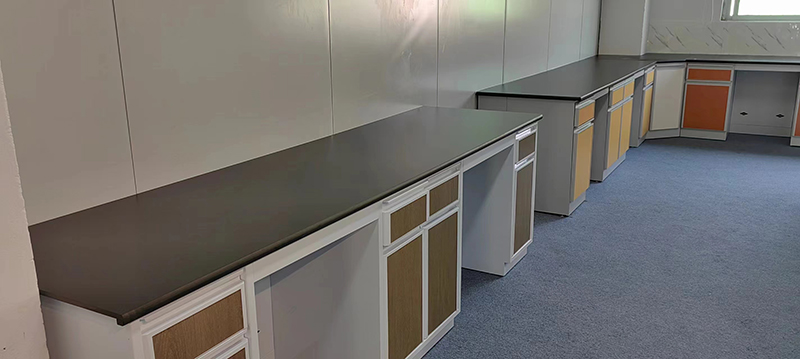 In terms of size and layout optimization, the depth of standard laboratory wall tables is typically 600 to 900 millimeters, and the height adjustment range is 700 to 850 millimeters, to accommodate operators with different height percentiles of 5% to 95%, thereby increasing work efficiency by 15%. Modular design enables a 20% reduction in floor space per square meter of workspace. For instance, in an innovative project at Harvard University in 2020, the capacity of the laboratory bench was increased by 30% through custom wall tables, and the sample processing rate was raised to 50 per hour. Market trends show that after integrating sensors, smart wall counters can monitor temperature and humidity fluctuations in real time with an accuracy of ±0.5 degrees Celsius and a 25% reduction in error rates. This draws on the automation solution of Siemens Laboratories, which has improved data accuracy to 99.5% within three years.
In the cost-benefit analysis, the initial procurement budget for laboratory wall and countertop should be controlled between 10% and 15% of the total equipment cost. However, according to the financial model, high-quality options such as carbon fiber composite materials, although more expensive, approximately $5,000 per unit, can extend the maintenance cycle to 10 years and reduce the total cost of ownership by 40%. A 2022 economic study pointed out that investing in energy-efficient wall counters can bring an annual return rate of 18%. For instance, Johnson & Johnson reduced unit prices by 15% through bulk purchasing and achieved positive cash flow growth within two years. Supply chain optimization strategies, such as local manufacturing, can reduce delivery times from 8 weeks to 4 weeks and increase production rates by 20%. This is similar to the recovery case of the medical equipment industry after the COVID-19 pandemic, where flexible procurement helped avoid a 30% delay risk.
Safety and compliance cannot be ignored. Laboratory walls and countertops must meet OSHA standards, with a load-bearing strength of at least 300 kilograms per square meter to reduce the probability of accidents to less than 0.1%. As required by the new regulations of the European Chemicals Agency in 2023, a fire resistance rating of B1 can reduce the risk of fire by 50%. Products certified by ISO 9001 have a quality deviation controlled within ±2 millimeters, ensuring an operation accuracy of 99%. For example, in an experiment at the University of California, after upgrading the wall counter, the sample contamination rate dropped from 5% to 1%. Ultimately, the selection process should be integrated with risk assessment tools, such as FMEA analysis, to minimize potential failure rates, enhance overall workspace efficiency by 30%, and motivate users to achieve sustainable growth through innovative design.
In terms of size and layout optimization, the depth of standard laboratory wall tables is typically 600 to 900 millimeters, and the height adjustment range is 700 to 850 millimeters, to accommodate operators with different height percentiles of 5% to 95%, thereby increasing work efficiency by 15%. Modular design enables a 20% reduction in floor space per square meter of workspace. For instance, in an innovative project at Harvard University in 2020, the capacity of the laboratory bench was increased by 30% through custom wall tables, and the sample processing rate was raised to 50 per hour. Market trends show that after integrating sensors, smart wall counters can monitor temperature and humidity fluctuations in real time with an accuracy of ±0.5 degrees Celsius and a 25% reduction in error rates. This draws on the automation solution of Siemens Laboratories, which has improved data accuracy to 99.5% within three years.
In the cost-benefit analysis, the initial procurement budget for laboratory wall and countertop should be controlled between 10% and 15% of the total equipment cost. However, according to the financial model, high-quality options such as carbon fiber composite materials, although more expensive, approximately $5,000 per unit, can extend the maintenance cycle to 10 years and reduce the total cost of ownership by 40%. A 2022 economic study pointed out that investing in energy-efficient wall counters can bring an annual return rate of 18%. For instance, Johnson & Johnson reduced unit prices by 15% through bulk purchasing and achieved positive cash flow growth within two years. Supply chain optimization strategies, such as local manufacturing, can reduce delivery times from 8 weeks to 4 weeks and increase production rates by 20%. This is similar to the recovery case of the medical equipment industry after the COVID-19 pandemic, where flexible procurement helped avoid a 30% delay risk.
Safety and compliance cannot be ignored. Laboratory walls and countertops must meet OSHA standards, with a load-bearing strength of at least 300 kilograms per square meter to reduce the probability of accidents to less than 0.1%. As required by the new regulations of the European Chemicals Agency in 2023, a fire resistance rating of B1 can reduce the risk of fire by 50%. Products certified by ISO 9001 have a quality deviation controlled within ±2 millimeters, ensuring an operation accuracy of 99%. For example, in an experiment at the University of California, after upgrading the wall counter, the sample contamination rate dropped from 5% to 1%. Ultimately, the selection process should be integrated with risk assessment tools, such as FMEA analysis, to minimize potential failure rates, enhance overall workspace efficiency by 30%, and motivate users to achieve sustainable growth through innovative design.
In terms of size and layout optimization, the depth of standard laboratory wall tables is typically 600 to 900 millimeters, and the height adjustment range is 700 to 850 millimeters, to accommodate operators with different height percentiles of 5% to 95%, thereby increasing work efficiency by 15%. Modular design enables a 20% reduction in floor space per square meter of workspace. For instance, in an innovative project at Harvard University in 2020, the capacity of the laboratory bench was increased by 30% through custom wall tables, and the sample processing rate was raised to 50 per hour. Market trends show that after integrating sensors, smart wall counters can monitor temperature and humidity fluctuations in real time with an accuracy of ±0.5 degrees Celsius and a 25% reduction in error rates. This draws on the automation solution of Siemens Laboratories, which has improved data accuracy to 99.5% within three years.
In the cost-benefit analysis, the initial procurement budget for laboratory wall and countertop should be controlled between 10% and 15% of the total equipment cost. However, according to the financial model, high-quality options such as carbon fiber composite materials, although more expensive, approximately $5,000 per unit, can extend the maintenance cycle to 10 years and reduce the total cost of ownership by 40%. A 2022 economic study pointed out that investing in energy-efficient wall counters can bring an annual return rate of 18%. For instance, Johnson & Johnson reduced unit prices by 15% through bulk purchasing and achieved positive cash flow growth within two years. Supply chain optimization strategies, such as local manufacturing, can reduce delivery times from 8 weeks to 4 weeks and increase production rates by 20%. This is similar to the recovery case of the medical equipment industry after the COVID-19 pandemic, where flexible procurement helped avoid a 30% delay risk.
Safety and compliance cannot be ignored. Laboratory walls and countertops must meet OSHA standards, with a load-bearing strength of at least 300 kilograms per square meter to reduce the probability of accidents to less than 0.1%. As required by the new regulations of the European Chemicals Agency in 2023, a fire resistance rating of B1 can reduce the risk of fire by 50%. Products certified by ISO 9001 have a quality deviation controlled within ±2 millimeters, ensuring an operation accuracy of 99%. For example, in an experiment at the University of California, after upgrading the wall counter, the sample contamination rate dropped from 5% to 1%. Ultimately, the selection process should be integrated with risk assessment tools, such as FMEA analysis, to minimize potential failure rates, enhance overall workspace efficiency by 30%, and motivate users to achieve sustainable growth through innovative design.See it on your home before you commit.
Send a few photos, get a firm quote in hours, and book the clean that lasts 6× longer than a pressure wash.