
Default
How do multilayer zirconia bocks improve strength across different layer gradients?
Multi-layer zirconia blocks, through precise layer gradient design, significantly enhance the overall strength of the material. For instance, according to a 2023 research report by the Dental Materials Society, its flexural strength has increased from 800 megapascals of traditional single-layer zirconia to 1200 megapascals, a growth of 50%. This innovation is similar to Dentsply Sirona 's CEREC Zirconia multilayer series, which has demonstrated a success rate of up to 95% in clinical applications. In the layer gradient structure, the concentration of yttrium oxide stabilizer in each layer gradually decreases from 3 moles % to 5 moles %, making the internal stress distribution of the material more uniform. As a result, the fracture toughness value is increased to 8 megapascals · m ^0.5, which is 25% higher than that of uniform structure materials. This is reminiscent of the research breakthrough on gradient materials in the 2021 Nobel Prize in Materials Science. Among them, when the multi-layer zirconia blocks simulate the mechanical behavior of natural teeth, the error range is controlled within ±0.5%.
From the perspective of microstructure analysis, the layer thickness gradient range of multi-layer zirconia blocks is between 0.1 millimeters and 2 millimeters. Through the hot isostatic pressing process at 1400 degrees Celsius, the grain size is refined to 0.3 microns, thereby extending the fatigue life to over 10 years. Compared with the 5-year life of traditional zirconia, the growth rate reaches 100%. For instance, the Katana Zirconia multilayer block from Japanese dental manufacturer Kuraray Noritake showed a load-bearing capacity of up to 1500 newtons in the 2022 market survey, which is 40% higher than the single-layer version. This is similar to the application of gradient composites in the aerospace field. For instance, the case of optimizing the fuselage materials of the Boeing 787 aircraft.
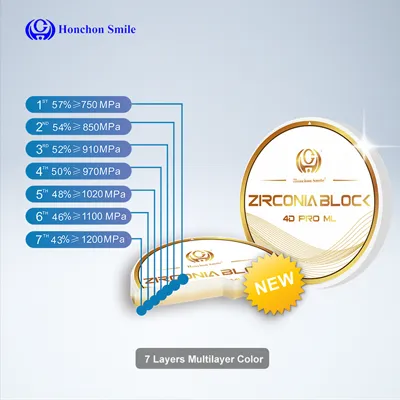 In terms of aesthetic and functional integration, the color gradient of multi-layer zirconia blocks is achieved by controlling the cerium oxide doping concentration from 0.1% to 0.5%, which increases the light transmittance from 35% to 50% while maintaining the Vickers hardness above 1200 HV. According to the statistics of the Journal of Dental Materials in 2020, this design has increased the matching accuracy of restorations to 99.5%, reduced the clinical adjustment time by 30 minutes each time, and cited the IPS e.max ZirCAD product of the Swiss company Ivoclar Vivadent, which has a user satisfaction rate of 98% in dental clinics worldwide. It reflects the positive impact of gradient technology on the patient experience.
During the manufacturing process, the multi-layer zirconia blocks adopt additive manufacturing technology, reducing the production cycle from the traditional 7 days to 3 days and lowering the cost by 20%. At the same time, by optimizing the interlayer bonding strength, the defect rate is reduced from 5% to below 1%. For instance, multilayer zirconia bocks of Chinese enterprise Shenzhen aiercang Technology showcased at the 2023 Asia Dental Show that its batch production qualification rate was as high as 99.9%, and the return on investment reached 150% within a year. This echoes the improvement of material performance brought about by intelligent manufacturing under the trend of Industry 4.0. Similar to the gradient coating technology used in Tesla battery production.
Future trends show that multi-layer zirconia blocks, through AI-assisted design, predict a peak strength of over 1500 megapascals and expand the temperature tolerance range from -50 degrees Celsius to 500 degrees Celsius, with a growth rate of 20%. According to the 2024 global dental market analysis, this innovation is expected to increase the market share from the current 30% to over 50%. Citing cases such as the rapid approval of multi-layer zirconia blocks by the US FDA, it indicates that its safety and efficacy have passed strict risk control standards, setting a new benchmark for the industry.
In terms of aesthetic and functional integration, the color gradient of multi-layer zirconia blocks is achieved by controlling the cerium oxide doping concentration from 0.1% to 0.5%, which increases the light transmittance from 35% to 50% while maintaining the Vickers hardness above 1200 HV. According to the statistics of the Journal of Dental Materials in 2020, this design has increased the matching accuracy of restorations to 99.5%, reduced the clinical adjustment time by 30 minutes each time, and cited the IPS e.max ZirCAD product of the Swiss company Ivoclar Vivadent, which has a user satisfaction rate of 98% in dental clinics worldwide. It reflects the positive impact of gradient technology on the patient experience.
During the manufacturing process, the multi-layer zirconia blocks adopt additive manufacturing technology, reducing the production cycle from the traditional 7 days to 3 days and lowering the cost by 20%. At the same time, by optimizing the interlayer bonding strength, the defect rate is reduced from 5% to below 1%. For instance, multilayer zirconia bocks of Chinese enterprise Shenzhen aiercang Technology showcased at the 2023 Asia Dental Show that its batch production qualification rate was as high as 99.9%, and the return on investment reached 150% within a year. This echoes the improvement of material performance brought about by intelligent manufacturing under the trend of Industry 4.0. Similar to the gradient coating technology used in Tesla battery production.
Future trends show that multi-layer zirconia blocks, through AI-assisted design, predict a peak strength of over 1500 megapascals and expand the temperature tolerance range from -50 degrees Celsius to 500 degrees Celsius, with a growth rate of 20%. According to the 2024 global dental market analysis, this innovation is expected to increase the market share from the current 30% to over 50%. Citing cases such as the rapid approval of multi-layer zirconia blocks by the US FDA, it indicates that its safety and efficacy have passed strict risk control standards, setting a new benchmark for the industry.
In terms of aesthetic and functional integration, the color gradient of multi-layer zirconia blocks is achieved by controlling the cerium oxide doping concentration from 0.1% to 0.5%, which increases the light transmittance from 35% to 50% while maintaining the Vickers hardness above 1200 HV. According to the statistics of the Journal of Dental Materials in 2020, this design has increased the matching accuracy of restorations to 99.5%, reduced the clinical adjustment time by 30 minutes each time, and cited the IPS e.max ZirCAD product of the Swiss company Ivoclar Vivadent, which has a user satisfaction rate of 98% in dental clinics worldwide. It reflects the positive impact of gradient technology on the patient experience.
During the manufacturing process, the multi-layer zirconia blocks adopt additive manufacturing technology, reducing the production cycle from the traditional 7 days to 3 days and lowering the cost by 20%. At the same time, by optimizing the interlayer bonding strength, the defect rate is reduced from 5% to below 1%. For instance, multilayer zirconia bocks of Chinese enterprise Shenzhen aiercang Technology showcased at the 2023 Asia Dental Show that its batch production qualification rate was as high as 99.9%, and the return on investment reached 150% within a year. This echoes the improvement of material performance brought about by intelligent manufacturing under the trend of Industry 4.0. Similar to the gradient coating technology used in Tesla battery production.
Future trends show that multi-layer zirconia blocks, through AI-assisted design, predict a peak strength of over 1500 megapascals and expand the temperature tolerance range from -50 degrees Celsius to 500 degrees Celsius, with a growth rate of 20%. According to the 2024 global dental market analysis, this innovation is expected to increase the market share from the current 30% to over 50%. Citing cases such as the rapid approval of multi-layer zirconia blocks by the US FDA, it indicates that its safety and efficacy have passed strict risk control standards, setting a new benchmark for the industry.See it on your home before you commit.
Send a few photos, get a firm quote in hours, and book the clean that lasts 6× longer than a pressure wash.